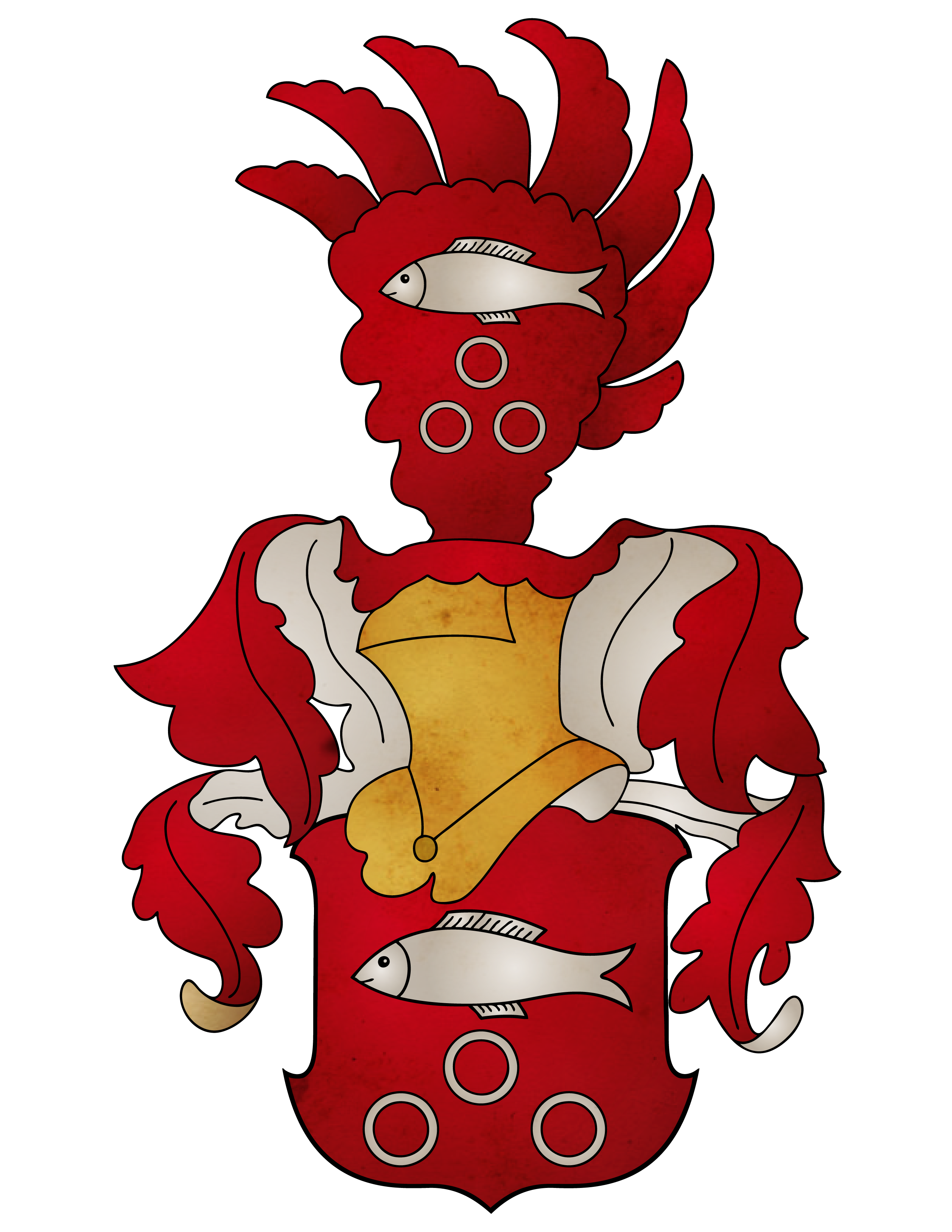
This page houses the information I have about the Wunderlich Family Crest. Or maybe I should say: The one my Father and his family seem most closely associated with sentimentally. In my research I have found several other versions that may well have attachment to my family line or yours. As time permits, I’ll post the information here and I would invite anyone with supplemental information to email it to me at mikecoins@gmail.com.
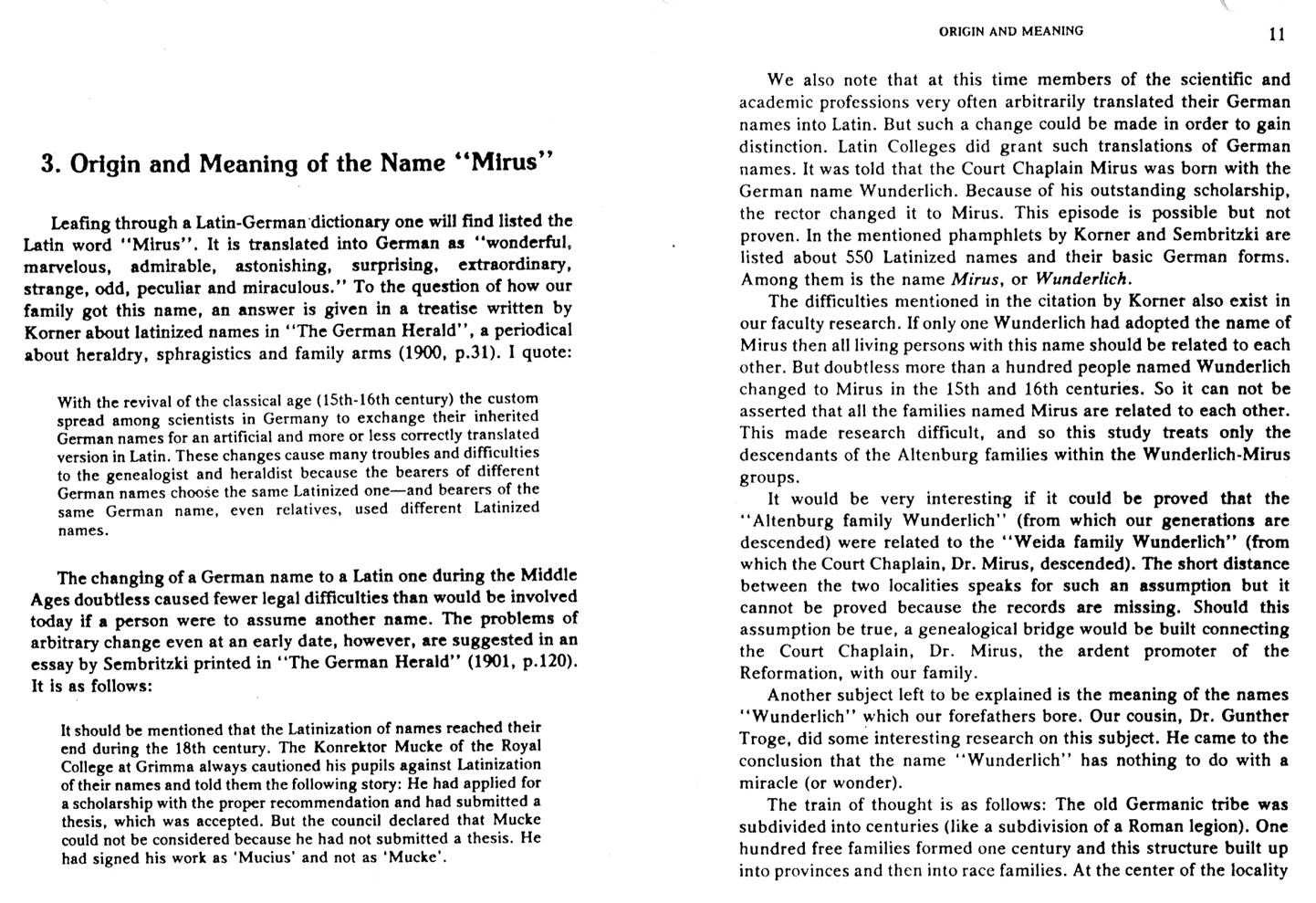
Origin and Meaning Of The Name Mirus
MW: This was an article included in the original family history book I was given. The copy I had was a scanned image of the text. Below is an easier to read optical character conversion (OCR) of the book scans in the original book. I also included the original scanned pages of the book. I could not find the name of the book which this was taken from.
Leafing through a Latin-German dictionary one will find listed the Latin word “Mirus”. It is translated into German as “wonderful, marvelous, admirable, astonishing, surprising, extraordinary, strange, odd, peculiar and miraculous.” To the question of how our family got this name, an answer is given in a treatise written by Korner about latinized names in “The German Herald”, a periodical about heraldry, sphragistics and family arms (1900, p.31). I quote:
With the revival of the classical age (15th-16th century) the custom spread among scientists in Germany to exchange their inherited German names for an artificial and more or less correctly translated version in Latin. These changes cause many troubles and difficulties to the genealogist and heraldist because the bearers of different German names choose the same Latinized one—and bearers of the same German name, even relatives, used different Latinized names.
The changing of a German name to a Latin one during the Middle Ages doubtless caused fewer legal difficulties than would be involved today if a person were to assume another name. The problems of arbitrary change even at an early date, however, are suggested in an essay by Sembritzki printed in “The German Herald” (1901, p.120). It is as follows:
It should be mentioned that the Latinization of names reached their end during the 18th century. The Konrektor Mucke of the Royal College at Grimma always cautioned his pupils against Latinization of their names and told them the following story: He had applied for a scholarship with the proper recommendation and had submitted a thesis, which was accepted. But the council declared that Mucke could not be considered because he had not submitted a thesis. He had signed his work as ‘Mucius’ and not as ‘Mucke’.
We also note that at this time members of the scientific and academic professions very often arbitrarily translated their German names into Latin. But such a change could be made in order to gain distinction. Latin Colleges did grant such translations of German names. It was told that the Court Chaplain Mirus was born with the German name Wunderlich. Because of his outstanding scholarship, the rector changed it to Mirus. This episode is possible but not proven. In the mentioned phamphlets by Korner and Sembritzki are listed about 550 Latinized names and their basic German forms. Among them is the name Mirus, or Wunderlich.
The difficulties mentioned in the citation by Korner also exist in our faculty research. If only one Wunderlich had adopted the name of Mirus then all living persons with this name should be related to each other. But doubtless more than a hundred people named Wunderlich changed to Mirus in the 15th and 16th centuries. So it can not be asserted that all the families named Minis are related to each other. This made research difficult, and so this study treats only the descendants of the Altenburg families within the Wunderlich-Mirus groups.
It would be very interesting if it could be proved that the “Altenburg family Wunderlich” (from which our generations are descended) were related to the “Weida family Wunderlich” (from which the Court Chaplain, Dr. Minis, descended). The short distance between the two localities speaks for such an assumption but it cannot be proved because the records are missing. Should this assumption be true, a genealogical bridge would be built connecting the Court Chaplain, Dr. Mirus, the ardent promoter of the Reformation, with our family.
Another subject left to be explained is the meaning of the names “Wunderlich” which our forefathers bore. Our cousin, Dr. Gunther Troge, did some interesting research on this subject. He came to the conclusion that the name “Wunderlich” has nothing to do with a miracle (or wonder).
The train of thought is as follows: The old Germanic tribe was subdivided into centuries (like a subdivision of a Roman legion). One hundred free families formed one century and this structure built up into provinces and then into race families. At the center of the locality of each century was the voting place (Walstatt) or holy grove. It was a part natural and part artificially fortified place. Here the tribes sacrificed to the gods and held court. In times of war and distress, women and children found safe asylum here.
Plenty of expressions, even today, can be traced back to the Walstatt, e.g. Dol, Pin, Horst, Lick and Lich. Lich can be found in numerous names of villages and cities, e.g.. Pfaffenlich and Julich. The syllable “lich” in the name Wunderlich, Troge thought, has only one meaning—”Walstatt”. So there remains only the meaning of “Wunder” or “Wund” to explain. Here there may have been a transition of sound over a period of time. “Wund”, may have been derived from Hund. Hund has the same meaning as Hundertschaft ,(one hundred head or a century). Wunderlich, therefore, indicates a leader in the Lich, Walstatt or, in otherwords, the leader of a Hundertschaft (century). Dr. Troge writes at the end of his thesis: “If our Altenburg ancestors had sensed the deep significance of this beautiful original Germanic name, they would certainly have remained as Wunderlich (Minis).”
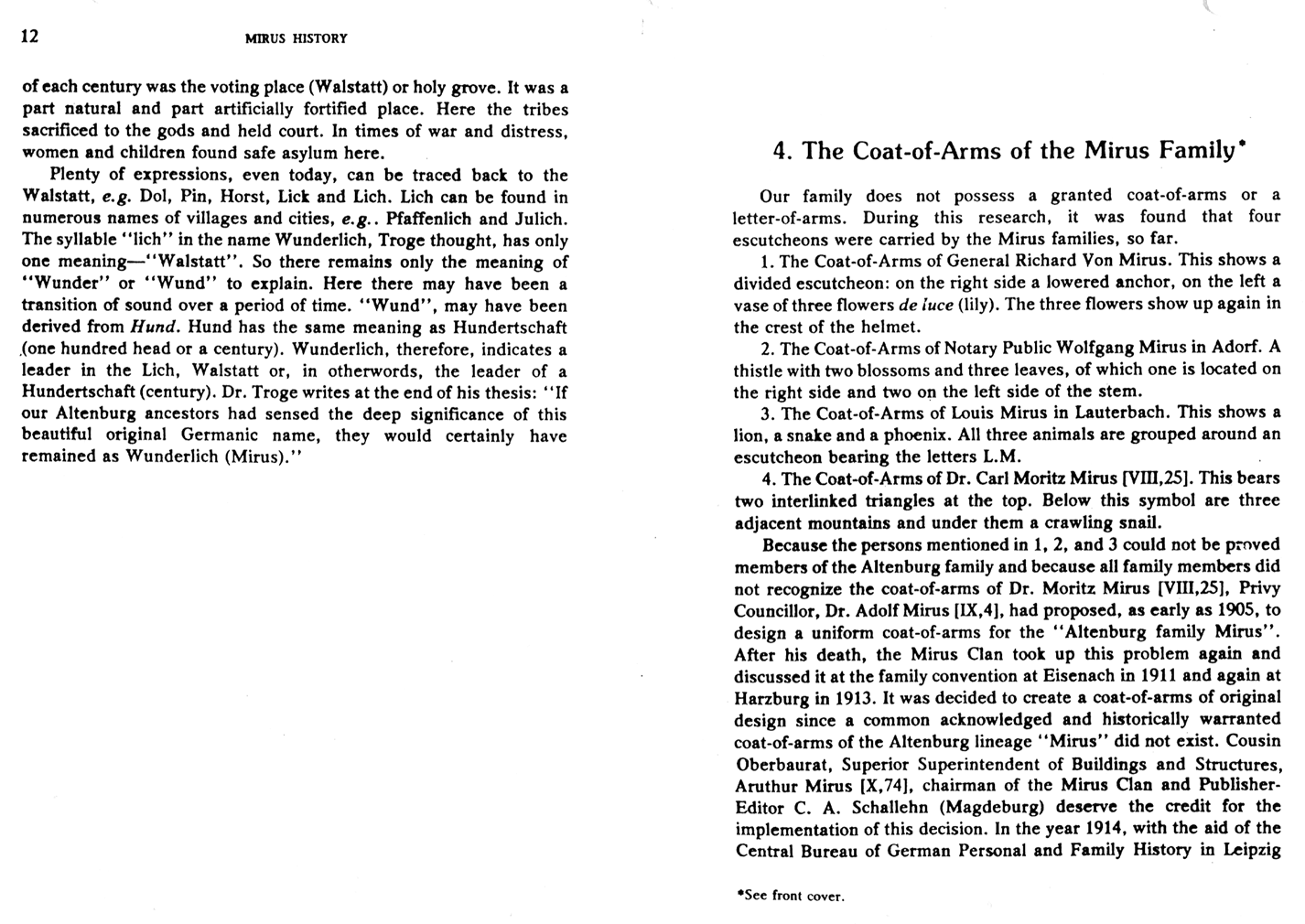
4. The Coat-of-Arms of the Mirus Family’
Our family does not possess a granted coat-of-arms or a letter-of-arms. During this research, it was found that four escutcheons were carried by the Mirus families, so far.
1. The Coat-of-Arms of General Richard Von Mirus. This shows a divided escutcheon: on the right side a lowered anchor, on the left a vase of three flowers de luce (lily). The three flowers show up again in the crest of the helmet.
2. The Coat-of-Arms of Notary Public Wolfgang Mirus in Adorf. A thistle with two blossoms and three leaves, of which one is located on the right side and two on the left side of the stem.
3. The Coat-of-Arms of Louis Mirus in Lauterbach. This shows a lion, a snake and a phoenix. All three animals are grouped around an escutcheon bearing the letters L.M.
4. The Coat-of-Arms of Dr. Carl Moritz Mirus [VII1,25]. This bears two interlinked triangles at the top. Below this symbol are three adjacent mountains and under them a crawling snail.
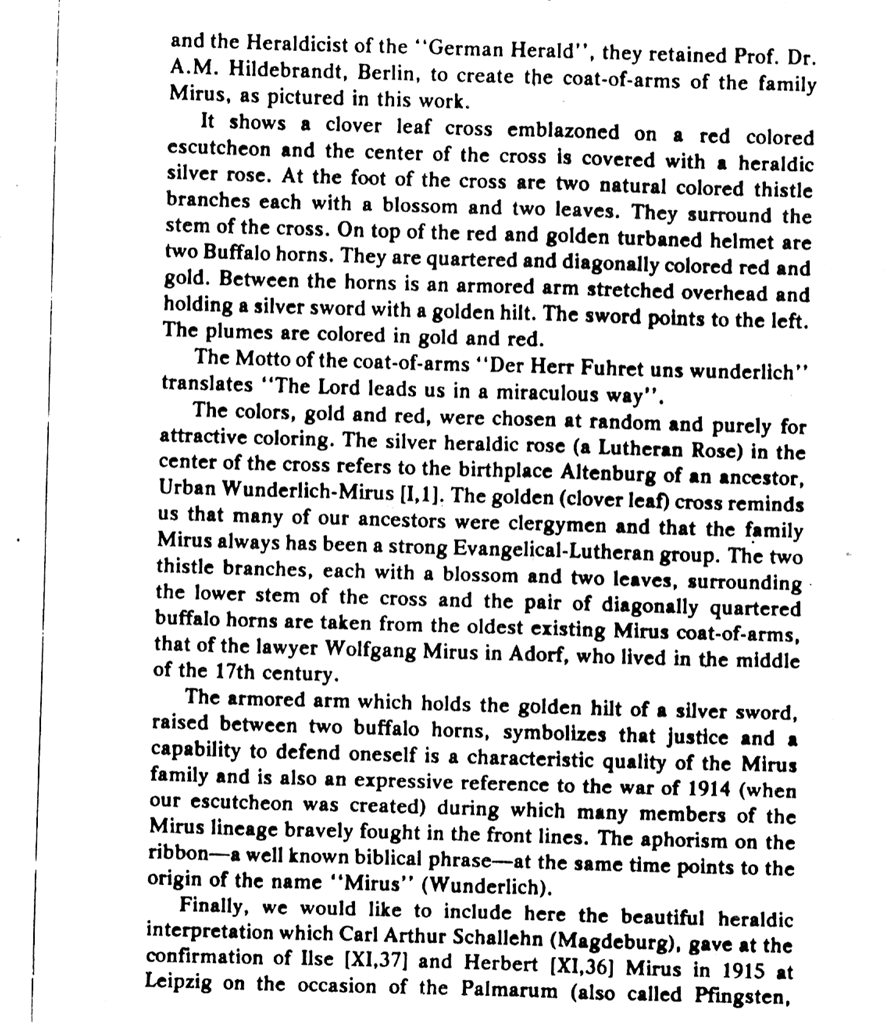
Because the persons mentioned in 1, 2, and 3 could not be proved members of the Altenburg family and because all family members did not recognize the coat-of-arms of Dr. Moritz Minis [VIII,25], Privy Councillor, Dr. Adolf Minis [IX,4], had proposed, as early as 1905, to design a uniform coat-of-arms for the “Altenburg family Minis”. After his death, the Mirus Clan took up this problem again and discussed it at the family convention at Eisenach in 1911 and again at Harzburg in 1913. It was decided to create a coat-of-arms of original design since a common acknowledged and historically warranted coat-of-arms of the Altenburg lineage “Minis” did not exist. Cousin Oberbaurat, Superior Superintendent of Buildings and Structures, Aruthur Minis [X,74], chairman of the Minis Clan and Publisher-Editor C. A. Schallehn (Magdeburg) deserve the credit for the implementation of this decision. In the year 1914, with the aid of the Central Bureau of German Personal and Family History in Leipzig
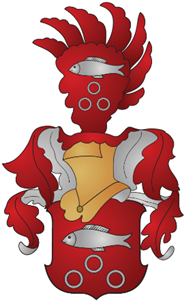
THE WUNDERLICH COAT-OF-ARMS # 1 Circa 1250 AD.
MW: This is a letter from my Great Uncle Jack to the family regarding his personal research on the family crest
Historical Information. FAMILIE WUNDERLICH Christmas 1987.
Written by John Henry Wunderlich.
After considerable urging from several people, I’ll tell all I know about the WUNDERLICH name and wappen (coat-of-arms). But before I even get started, I should set the record straight. There may very well be more precise versions or even contradictory data about our history; I’m giving you what I learned in my research while stationed in Germany ‘63- ‘ 65. Further investigations are up to you if you desire more details.
The name was patented in Switzerland circa 1206 by Lutti (who then became Lutti Wunderlich). This conformed to local pressure to acquire and establish family names. The single, or first only, names which were all that were used at that time were causing too much confusion as villages grew larger. “wunderlich” was/is a German adjective meaning ‘strangely wonderful’, ‘ahead of his time’ and/ or ‘curious’: attributes Lutti is alleged to have had. (Some cynics claim it just means strange or queer!).
About three or four centuries later, another of our ancestors (I think Hans) became an important owner of a fleet of fishing boats near Potsdam, Germany. In those times, someone who had land or goods had to protect them himself, so ‘land barons’ armed enough of their loyal workers to provide estate security. The wappens, or coats-of-arms, evolved as a means of identifying “us” and “them” during times of conflict.
The fish on our family coat-of-arms probably symbolizes the fishing fleet that contributed to the estate. The other symbols may be the result of an attempt to make the family (estate) crest more decorative or heroic. Or they could symbolize some significant event. There is no crown in our wappen that indicates that there was no royal blood in the family (no great loss by anything I know of royalty!!).
From various and sundry sources, I’ve learned that there are at least two other Wunderlich coats-of-arms. My advisor (Col. Hans Wunderlich of the German Army) told me the ‘fishy’ one was clearly ours but that extensive research would be necessary to claim one of the others. Oh well, one is enough for me for now. Except for the names and dates below, I’ve told you all I know, and some that I don’t know!!
Love ya all, Jack Wunderlich
John Henry (Jack) b. Mar 20 1921 Burwell, Nebraska.
William Martin b. Oct 3, 1877 Winona, Minnesota.
Henry b. Mar 9 1843 Belleville, Illinois.
Andrew b. Apr 23 1806 Dieburg, Hesse-Darrnstadt Germany.
He came to the USA (Illinois) in 1840.
Notes On Family Crest Research From Michael Wunderlich
In 2019 I became interested in updating the family book/binder that my father Robert Wunderlich and my mother Mary Theresa Wunderlich (Dixon) had given to me many years earlier. As part of this, I wanted a high-quality graphic of our family crests completed and I engaged with an artist friend of mine name Chris Mackey. Chris, as it turns out, receives requests like this quite often and as a result has invested quite a bit of time in learning about Heraldry to help him recreate family crests as authentically as possible. He provided an interesting perspective that I thought I would share.
Before I get started I’ll give you the same warning as Great Uncle Jack in his 1987 note:
“There may very well be more precise versions or even contradictory data about our history; I’m giving you what I learned in my research. Further investigations are up to you if you desire more details”
When I initially presented Chris with the request, I provided a photo of a painting of the Coat of Arms that my Grandmother Thelma Wunderlich (Moss) had made and that several family members were given copies of at one point. One of these copies was at my father Robert’s house. I also provided a photo of an old patch with a very similar version of the crest. There are a few notable differences between the versions but by and large – they are the same.
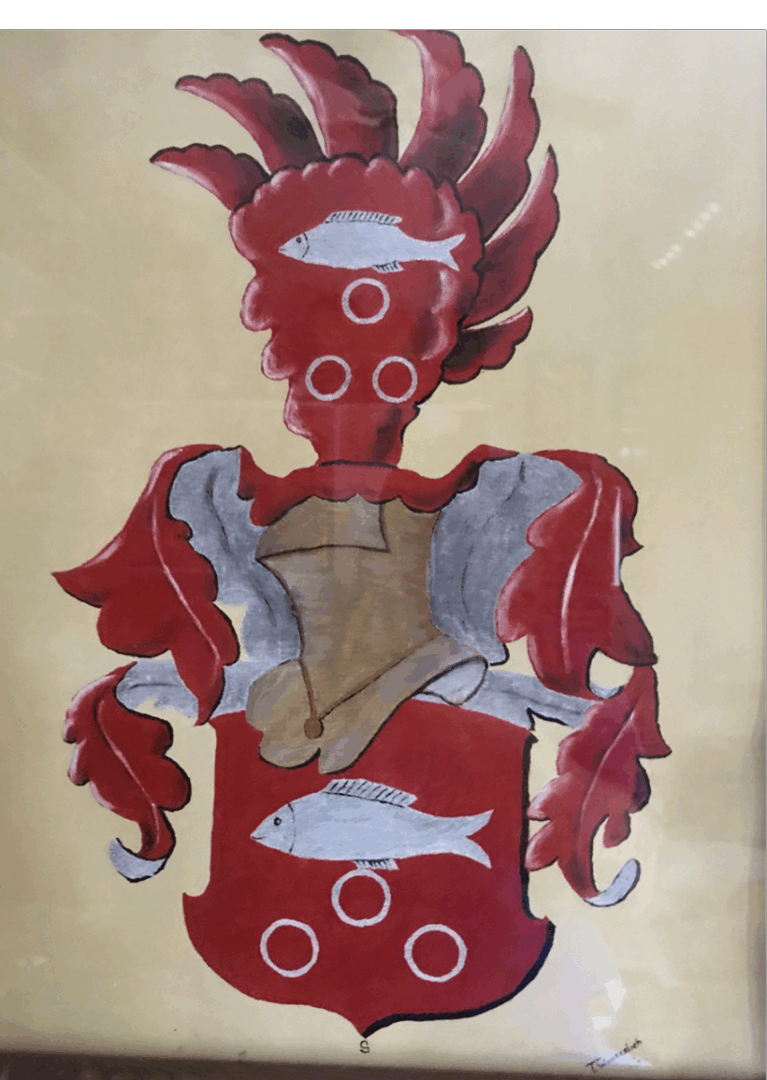
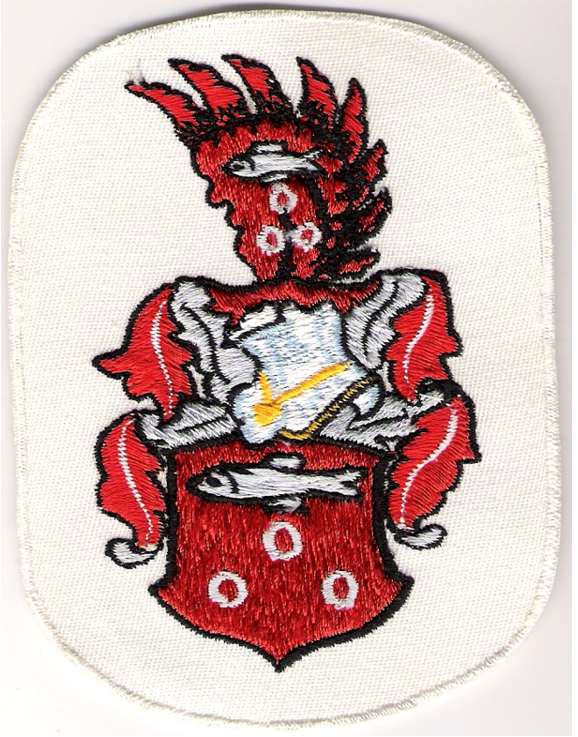
Having presented these references to Chris he studied them and replied that he suspected the versions I supplied had “evolved” from the original over time. He said in his experience that most everything except the main shield in a Coat of Arms is sort of “decoration”. He was asking me how much time I wanted invested on the project because he could either reproduce the Wunderlich Crest exactly as submitted (which would take more time) or he could use some stock art from a service to which he subscribes to quickly add similar decorations around the main shield component. His unsentimental opinion was the only “important” part was likely the shield – the rest being just for looks. I know there is a strong attachment to the painted version, at least in my immediate family. So I asked for both.
In our correspondence he informed me the he believed the element at the very top (the crest) was probably supposed to be an Eagle’s wing. And that the helmet above the shield was likely different originally. Here’s his words to me:
Here’s a quick example of what I was talking about. The painting from an embroidered patch, that in turn probably came from a painting of another painting, etc., etc. The plume over the helmet was actually an eagle wing originally way back in the day. The helm had a gorget, not a necklace and the funny shape of the lower edge of the helm was actually a triparte shield border. This is just like my family crest was, too. A version from a version from another version that slowly became distorted.
He also provided the following illustration which I found compelling.
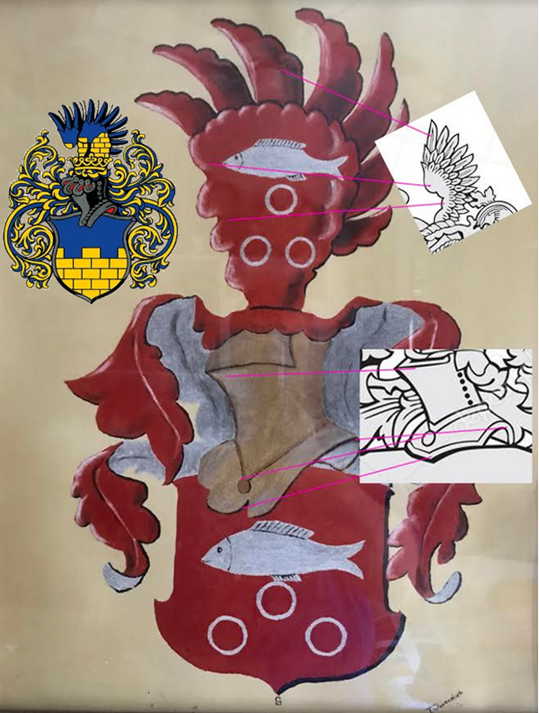
If you look at the two sources I had – the patch and the painting – You can see the main feathers clearly. You can also see “swirls” on the top area. They are in white on the painting, in black on the patch. These are the second and third layers of feathers. I later found a reference describing the crest as “Wing like a shield”.
Chris also mentioned the repetition of the charge (fish and rings) on the shield and crest (feather-hat-thing) was very unusual and probably not original based on his research.
This caused me to do a little armchair detective work. I was searching for other crests with similar design aspects to validate the suspicion. I found one fairly quickly… the Coat of Arms for the German city of Bautzen. This in turn lead me to search for “German Heraldic Tradition” which turned up a Wikipedia article on the topic.
I then also found the “Wappenbuch” of Zurich in which there were many Coat of Arms with this shield and crest repetition.
In the wikipedia article https://en.wikipedia.org/wiki/German_heraldry there are a few key points important to our Coat of Arms:
The German heraldic tradition is noted for its scant use of heraldic furs, multiple crests, inseparability of the crest, and repetition of charges in the shield and the crest.
The “frilly stuff” on our Coat of Arms is tame by most standards in the world of Heraldry. Which lines up with this information. And the repetition of the charges in the shield and crest are common in German Heraldry. So, the repetition made sense.
As in other European heraldic traditions, the most prominent among the birds and beasts are the eagle and lion.[3] These two charges in particular had a special significance in Germany, where the eagle became symbolic of the Holy Roman Empire, and the lion came to represent certain feudal lords.[4]
This could reinforce that the crest is indeed an Eagle Wing.
The following paragraph is based only on my research, YMMV:
I believe our German family was Catholic. The political climate in Germany in the mid-1800’s was driven significantly by an emerging conflict between the religious oversight of the Roman Catholic church and the emergence of prominent Noble families who wished for more unification and secularization of the region. This culminated in the late 1800’s in the “Kulturkampf” which is directly translated as “culture struggle”. I believe it’s likely that the rising conflicts within Germany (see: German Revolutions of 1848-1849) as well as the increasing conflict between the German Imperial Government and the Roman Catholic Church, resulted in a lot of stress for Catholics and many others in Germany around that time. I suspect this to be a key motivation for Andreas (Andrew) immigrating with his family to the United States in 1840. It was time to “get out of Dodge”, so to speak.
This is supported by a note from my Great Uncle Jack Wunderlich in a description of an updated Coat of Arms that was commissioned ~1995/1996. Details on that version are included later.
I think it’s very likely whoever made the patch did so from a third rendering which is unknown to me, but in the process the embroiderer was forced to remove some fine detail from the crest to make it work on a patch. Thomas Wunderlich also provided some information which I found online. It is shared later in this book and that information reinforces that it is indeed an Eagle wing. The description he provides of our Wappen reads: “Wing Like shield”. I suppose this could mean a shield which looks like a wing, or a wing which is acting like a shield.
Historical Information Written by John Henry Wunderlich
This wappen belongs to us.
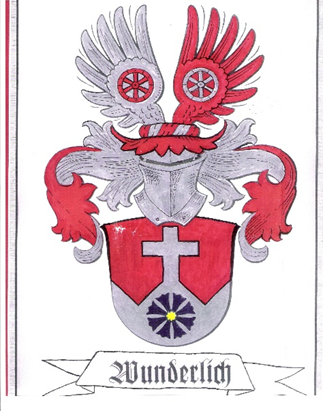
In @ 1995, John Ryan Wunderlich (Aunt Mary’s grandson) hired design specialists in Germany to depict the history of our ancestral family in a wappen. Cousin Frannie and I financed the project and John Ryan brought it to fruition; it is now on file in the Bibliothek.
This one starts with Andrew and Elizabeth (great Grandparents). It depicts a background in farming and industry, the lack of nobility (whew!) and the intense devotion Andrew and Elizabeth had for the Catholic faith. That’s the reason they migrated to the USA in the early 1800’s. They simply refused to convert when the heads of state flipped (check European history).
Wilfred Wunderlich Preserved Research
Wilfred Wunderlich had a website in the late 90’s, early 2000’s dedicated to Wunderlich family history. It is no longer active, but I was able to find it in the Internet Archive:
https://web.archive.org/web/19991003020646/http://www.island.net/~wilf/index.html
I am working to preserve the information from that website within this book. The information he had there was a treasure trove.
Letter from Thomas Murray Wunderlich
Some notes I took at the Cambridge Public Library while touching up this photo from my ring;
A family’s Achievement is shown in two tinctures. One is the color: ours is red, or “gules,” and is shown as vertical bars The other is metal: ours is silver, or “argent,” and is shown as a border without the bars.
The Crest refers to that part of the achievement over the helmet. For some families this is different from what is shown on the shield: not ours. I’ve read references to a cock’s comb but have only seen one other, on a different Wunderlich achievement
The wreath was two rolls of silk or leather encircling the helmet to support the crest. In German heraldry this is shown as five or seven twists: color-metal-metal-color.
The helmet is usually shown in one of four positions, to indicate rank. The one most often used is like ours, indicating a rank of esquire (candidate for knighthood) or gentleman. Next is the same type, but facing you, the viewer, indicating a knight. Next is a helmet with bars over the face instead of a visor, looking to the side, indicating a duke, a viscount, marquise, etc. Last is the barred helmet facing you, indicating royalty. A helmet was made of steel, not silver; Many people I read, show it as black
I’ve seen Medals on several achievements but only read a couple of references to them. They mentioned “knights of the order of ……” but that would seem inconsistent with Great Great Grandpa’s Helmet position.
The Mantel was a cloak, or coat of arms, attached to the helmet, worn to protect the armor from the sun (hot in there) and rain (cold in there plus rust). It’s usually shown very fancifully as ragged and blown to indicate the wearer has seen battle, but the more I read the more I wonder if that didn’t include jousting tournament. Apparently, to be heralded meant the trumpets were blown when your colors entered the field. The mantle is usually shown as color on the outer surface, metal on the inner surface.
There are many terms to describe positions of objects or animals on the shield or crest; you may have heard of “lion rampant” “Ours has a fish, Niaint:” horizontal as if swimming
Rings or Annulets, represent liberty and nobility. Their circular form represents strength and eternity. A ring can also be a symbol for the fifth son. Some English translations I’ve heard for Wunderlich, and adjective: “wondrous”, used in German fairy tales, “astonishing” and even “awe inspiring,” used in the bible.
Some well known Wunderlichs: Fritz, an opera tenor; Paul, a New York painter, Jerry, a Hollywood set designer(the only one we know we’re related to); Carl, who ascertained in 1868 that familiar figure 98.60F. Carl is the only one I’ve heard who is not an artist of some sort. The only one I’ve ever met out of the blue is Renner, a Cambridge filmmaker.
For any questions about Lotti Wunderlich’s move from Switzerland almost 800 years ago, or his fishing fleet, or the German word for achievement, ask Grandpa John Henry Wunderlich of Lincoln Nebraska.
I found all of this to be pretty interesting stuff, and I’ll bet most libraries would have at least one book on heraldry. If anyone wants to learn more, please let me know!
The efforts above were the work of
THOMAS MURRAY WUNDERLICH
<address redacted>
He’s the son of John (Jack) Henry Wunderlich of Lincoln Nebraska and will, no doubt, continue in his genealogical studies. Since it is an never ending task, his contribution should prove of great value.
WUNDERLICH, Geschlecht in Zurich. Lutti Wunderlich der VischervonUrickon ward 1419 Burger. Hans Wunderlich 1495 Zwolfer bei den schiffleuten. Jacob Wunderlich 1675 Zwolfer bei dem Weggen + 1680.
WAPPEN: In R. an der haptstelle ein Quergelegter s. Fisch darunter drei (1,2) s. Ringe. Helm: Fluegel Wie schild. Decken R.S.
MW: This is the letter as found on Wilfred Wunderlich’s website. Thomas is the son of Jack Wunderlich who provided the 1987 letter referenced earlier.
The last two paragraphs translated:
WONDERFUL, gender in Zurich. Lutti Wunderlich the VischervonUrickon became a citizen in 1419. Hans Wunderlich 1495 Zwolfer with the ship people. Jacob Wunderlich 1675 Zwolfer at the Weggen + 1680.
COAT OF ARMS: In R. at the haptic point a cross-section s. Fish including three (1.2) s. Rings. Helmet: Wing Like shield. Blankets R.S.
Information From Jens Wunderlich’s Webpage
[MW: This webpage is also gone, but the information is preserved below. I pulled this from the Internet Archive as well.]
I found the following information in “Großes Buch der Familiennamen” from Horst Naumann (Falken Verlag 1996): the name appeared first in 1372. The name comes from the old Middle High German word “wunderlich” and means to be wondrous, moody, eccentric, strange, odd, maybe hot-tempered.
The Wunderlichs came from Frankfurt/Main (Germany). The oldest known ancestor is Hans Wunderlich. He became a citizen of Frankfurt a.M. in 1579. The family went to Hamburg in 1668. From there family members went to Quedlinburg, Kiel, Malaga and Mecklenburg. From Mecklenburg one branch of the family went to West Prussia and came back after World War I. In the 1930s family members were known in Schwerin/Meckl., Rostock, Kolberg, Allmerswind, Berlin, Kassel, Malaga and North America.
At the Wunderlich Family Homepage from Wilfred Wunderlich, which unfortunately no longer exist, I found a letter from Thomas Murray Wunderlich which indicated a swiss origin of a part of our family (my translation):
“WUNDERLICH: Family from Zurich. Lutti Wunderlich fisherman from Urickon became a citizen in 1419. Hans Wunderlich 1495 Zwolfer at the seamen. Jacob Wunderlich 1675 Zwolfer at the Weggen + 1680.
CREST: Red, In the main part a lying silver fish, underneath three (1,2) silver rings.
HELMET: Wings like shield. Blankets red/silver.”
I’ve heard about the following Wunderlich family crests:
The family crest in the left belongs to our part of the family.
You can find it in “Großes Wappenbilderlexikon der bürgerlichen Geschlechter Deutschlands, Österreichs und der Schweiz” (Weltbild Verlag, Augsburg 1992).
Thomas Murray Wunderlich described this family crest belongs to a swiss branch of our family.
The second family crest is used by Destillerie & Likörfabrik Adolf Wunderlich Vienna.
[MW: A link in the wayback machine to the distillery page translates as:
Welcome to Wunderlich Vienna!
Since 1897 we have been producing exquisite distillates and liqueurs as a family business in Vienna Neubau. On these pages we offer you information about our products as well as the history of our company. Please use the selection on the left to select different sections. Product orders, inquiries and comments can be sent directly to us by e-mail. We appreciate your interest!
Wunderlich Rossbacher – the herbal specialty
The most famous product of our house is still a classic, popular as a digestive as well as an invigorating refreshment.
Rossbacher still appears to be sold. I found a link where the following was said:
Rossbacher is a drink that is made for real men and not for girls or boys, so this site is dedicated to real men’s topics: the best local tips, the best men’s slogans and the latest technology for real men.
The source of Rossbacher lies in the heart of Austria, in a bygone era. More precisely, in 1897. (Ver) strange, but true: this year, Adolf Wunderlich founded his small, fine liqueur factory at the age of 19, and Rossbacher’s triumphal march began.
A success story that will be continued in the new millennium!
Well… I guess they were right: It is still available, although it appears the Wunderlich name is no longer associated to it. I could not find a bottle within the United States!
I included a picture of the spirit which I found on the internet.
Now… back to the info from Jens…]
As far as I know the third family crest was created for a family reunion in Canada some years ago.
I found the crest in the right in “Wunderlich Familien-Weltbuch” (Halbert’s Family Heritage International Inc., USA 1997). They say the source is J. B. Rietstap’s “Armorial General” 1874 with the following description:
“Waagerecht geteilt; Oben rot, ein silbernes Kreuz; Unten silber und rot gerautet.”
[MW: Translated: Divided horizontally; Above red, a silver cross; Grated silver and red at the bottom]
I found another description of a Wunderlich family crest without source:
“Durch einen Rebstock geteilter Schild, dessen rechte Seite (vom Beschauer) zwei grüne Weintrauben und ein grünes Blatt im roten Felde enthält. Die linke Seite enthält im silbernen Felde zwei rote fünfblättrige Rosen, deren Mittelstück gold ist. Zwischen den Blättern sind goldene Randblätter. Die Helmdecken sind silber und rot.”
[MW: Translated: “Shield divided by a vine, whose right side (by the beholder) contains two green grapes and a green leaf in the red field The left side contains in the silver field two red five-petalled roses centered in gold, between the leaves are golden margins. The helmet covers are silver and red.”]
Artists
- Fritz Wunderlich: German opera tenor, especially Mozart and Strauss
born 26.09.1930 in Kusel, died 17.09.1966 in Heidelberg
since 1960 Bavarian Opera Munich, since 1962 Opera Vienna
( Discographie etc., Tenorland) - Paul Wunderlich: Painter
born 10.03.1927 in Berlin
1951-1963 Landeskunstschule Hamburg, 1963-1968 Professor at Hamburger Akademie, then New York - Heinz Wunderlich: organist, especially Bach and Reger
born 25.04.1919 in Leipzig
1943-1957 Kirchenmusikdirektor in Halle/Saale, 1958-1982 in Hamburg St. Jacobi, Professor at Musikhochschule Hamburg - Klaus Wunderlich: German organist, Hammond organ
born 1931, died 1997
( Homepage) - Christian Wunderlich: German actor and pop singer
born 1979
( Homepage)
Scientists
- Hans-Georg Wunderlich: Geologe
born 19.01.1928 in Stuttgart, died 28.05.1974 in Stuttgart
since 1963 Professor in Goettingen, since 1970 in Stuttgart; - Karl Reinhold August Wunderlich: Internist
born 04.08.1815 in Sulz/Neckar, died 25.09.1877 in Leipzig
1843 Professor in Tuebingen and 1850 in Leipzig;